


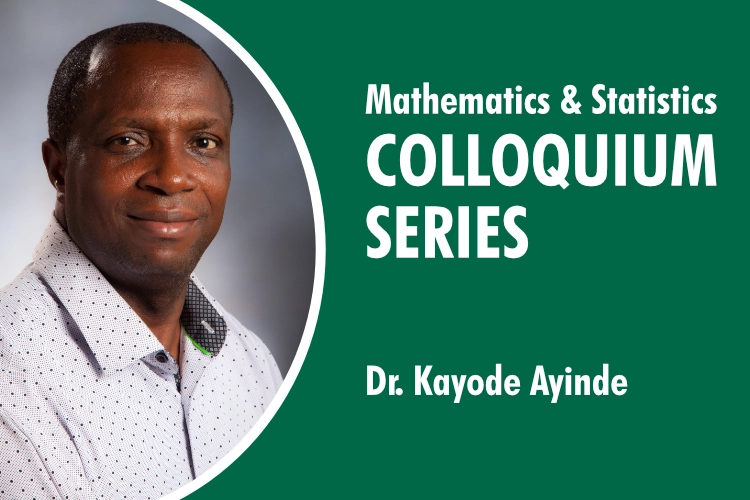
Mathematics and Statistics Colloquium Series #6: Democratically Elected Average of Numerical Data Sets
The School of Mathematics and Statistics presents the sixth installment of its 2025-26 Colloquium Series, "Democratically Elected Average of Numerical Data Sets: Simulation and Application Perspectives" with Assistant Professor Dr. Kayode Ayinde.
The presentation includes a Q&A session, and light refreshments will be provided.
Abstract: In a world awash with data, even something as simple as “finding the average” can lead to conflicting results when data are skewed, multi-modal, or contaminated by outliers. This study introduces the Democratically Elected Average (DEA), a novel framework that formulates average selection as a voting process among candidate estimators. Using five voting methods, namely, plurality, Borda count, approval, score, and Condorcet, each observation votes for the estimator that minimizes its deviation. The approach is evaluated through Monte Carlo simulations under diverse distributions and contamination scenarios, as well as bootstrap resampling of real datasets. Performance is assessed using bias, variability, mean absolute deviation, and mean squared error, with structured tie-breaking strategies for multiple winners. The results not only highlight the potential of voting-based estimation to unify consensus, robustness, and representativeness in a single summary statistic but also address the challenge of choosing a single value to represent complex data sets.